

Quality at Techcollege


'Quality by intention' – a common model for quality work at Techcollege
Background and purpose
Based on our strategy, Techcollege has developed a new quality model – 'Quality with intention' – which creates the foundation for the strategic ambition for quality work to be developed. The goal is to establish a coherent quality system that, across the institution's various programs, sets the framework for us to systematically develop our programs – for the benefit of students' learning and well-being.
Excerpt from Development with Intention
Education is our core mission – and our justification. We must continuously strive to become better at what we do – for the sake of our students. Techcollege must therefore be developed as an innovative learning organization that systematically works to improve the quality of our education and the teaching of our students. We will develop and establish a learning, evaluation and quality culture at all levels of the organization, where it is natural that speech is supported by data, and that data is supported by speech. Techcollege must therefore work systematically to collect qualitative and quantitative data that supports our joint work to develop the quality of education. A meaningful quality system must be developed that ensures that we continuously use our data to create dialogue about developing the quality of our education – not because data is the answer to everything, but because data gives rise to asking the right questions.
The quality system is based on the Executive Order on Vocational Education and the Executive Order on Upper Secondary Education, which define the legislative framework for the quality work at Techcollege. However, the Executive Orders allow schools to largely design and formulate their own quality systems, so that the quality system best matches local needs. In designing the quality system, the school therefore has a number of degrees of freedom to decide for itself which methods, evaluation processes, data sources, etc. are most relevant to use and include in relation to creating the strongest possible quality development in the school's education programs.
With this in mind, Techcollege has decided to create a common cross-cutting quality system that (with the necessary and relevant variations) encompasses both the vocational education and the upper secondary education at Techcollege. In doing so, Techcollege creates the opportunity to set a common strategic direction for the quality work at the school, while at the same time the common system framework enables common cross-cutting efforts and knowledge sharing across educational boundaries. The common quality system should thus be seen as a lever for developing a strong quality culture throughout the school – for the benefit of students' learning and well-being in both upper secondary and vocational education.
The quality model at Techcollege thus has two main purposes:
Create a clear strategic and organizational framework for the institution's ongoing quality work, centered around strengthening student learning and well-being
Ensure that Techcollege meets the current legislative requirements and guidelines for quality work in both vocational and upper secondary education.
Below, the quality model at Techcollege is developed and specified by reviewing the overall model and structure as well as the organization and annual cycle for the quality work at Techcollege.
The four core elements of the quality model
The quality work at Techcollege is built around the model below, which illustrates that quality work is fundamentally about developing and strengthening student learning and well-being – and that this should be the main focus of all quality work. The model also identifies the following four core elements of quality work, which are crucial in the effort to strengthen and develop student learning and well-being.
Under Pedagogy, we zoom in on the quality of our pedagogical didactic methods – and on the implementation of our pedagogical learning culture.
With Knowledge, we focus on the professional foundation for our education programs – and focus on whether our teaching is based on the latest knowledge about the subject/profession/industry.
Study environment deals with students' well-being - and how we can strengthen the framework around both the physical and psychological study environment.
During Market, we engage in dialogue with our most important external stakeholders about how they experience and evaluate our education programs – because they can teach us how to create quality education programs. In addition, the dialogue should teach us how to create good external collaboration around creating quality in students' apprenticeships and in transitions in the education system – both in (primary school) and out (higher education).
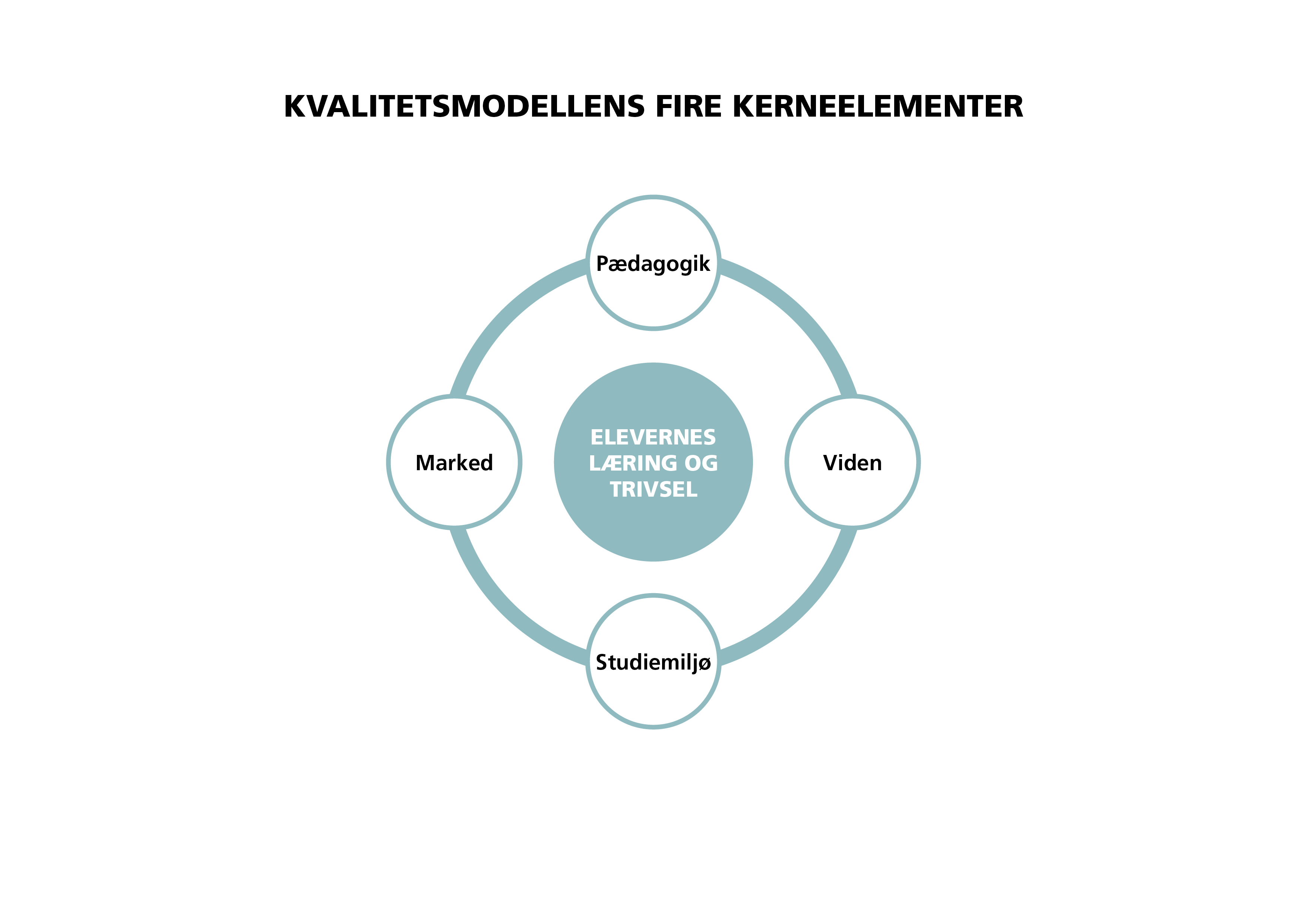
The goal of this model is to ensure that we reach all the way around the student and thus create a holistic picture of where and how we can develop our education programs - for the benefit of the students' learning and well-being.
Structure for quality work
The model below illustrates the overall structure of the quality work in Techcollege, where the quality work is fundamentally structured in two mutually dependent tracks:
Continuous quality development – which is the part of the quality work that continuously takes place throughout the organization every single day
Fixed structure – which defines four fixed elements in the quality annual wheel (quality goals, self-evaluation, follow-up and performance assessment)

The individual elements of the model are further explained in the sections below.
Central to the quality work at TECHCOLLEGE is the ongoing quality development, which is the daily ongoing quality work, and which consists of continuous alternation between the three sub-processes described below; Information collection, Dialogue and process, and Learning and action.
Information collection includes the ongoing collection, analysis and assessment of data. Data collection is carried out in relation to the quality goals set by TECHCOLLEGE (see section below) and therefore also includes an ongoing performance assessment in relation to the set quality targets. The purpose of information collection is to create a data-based basis for all processes in the quality work, so that data becomes the foundation on which the quality work is built. Data in this context is characterized by including both qualitative and quantitative data sources - and often combined with each other, for example so that a quantitative study (e.g. teaching evaluation) is followed up by qualitative dialogues (e.g. with the students). The specific data collection in relation to the individual quality target is determined in connection with the definition of the individual target, see section below and will at least include the following data areas:
The national surveys for student well-being (ETU) and company satisfaction (VTU), respectively
TECHCOLLEGE's own teaching evaluations
Other key metrics for admissions, dropouts, training agreements, employment and transition rates, grades, etc.
In addition to the firmly defined data collection in relation to the quality targets, it is possible to supplement with more ad hoc data collection and analysis, if it is deemed relevant to further elucidate an identified quality challenge.
Dialogue and process – it is absolutely crucial that ongoing quality development does not only deal with the collection of data, but also focuses on how data is used to create systematic and dialogue-based development processes – all of which aim to identify efforts and initiatives that can strengthen students’ learning and well-being. The very core of the quality system is thus the ability to use data as a basis for these learning processes, where at all levels of the organization data is used as a basis for asking good, curious and critical-constructive questions to each other. In the development of the quality model, there must be a special focus on the fact that dialogue-based use of data requires both trust and training – trust that the purpose is learning – and training in using data for critical-constructive dialogue.
The systematic dialogue processes take place both in educational contexts such as team meetings (PLF meetings), department meetings, etc. as well as in more cross-disciplinary management contexts such as management groups, management boards, etc.
Dialogue processes must be largely driven by employees and also include the involvement of both students and external stakeholders. The specific requirements for the process-related use of data regarding the set quality targets are specified in connection with the definition of the individual target, cf. the section on 'quality targets' below.
Learning and actions – our data-based dialogue processes only create value when they create insight and learning that leads to concrete actions aimed at strengthening students' learning and well-being. It is therefore crucial that the quality system sets the framework for ongoing initiatives and efforts in relation to the learning and insight that the dialogue about data creates. The specific requirements for documentation of both learning and actions are further specified in the section 'organisation of quality work' below.
Performance assessment of the achievement of the set quality goals is carried out continuously throughout the year, as part of the ongoing information collection. The structure for the quality work also stipulates (see the model above) that an overall assessment of the quality of the institutions' education programmes is carried out once a year, so that an overall overview of the development in the quality of education is created. Specifically, this overall performance assessment is prepared for the calendar year, which takes place in the period January-February, so that the overall performance assessment can be published on the school's website no later than 1 March.
However, it is important to emphasize that the annual overall performance assessment does not replace the ongoing performance assessment, which remains crucial for creating a proactive and engaging quality system that delivers current and relevant data.
In turn, the annual quality review helps to create an annual, coherent overview of the development in the quality of the programmes, including raising awareness of any quality challenges at the institutional level. Furthermore, the overall overview of the quality development at the institution is used as a basis for decision-making when selecting theme(s) for the annual self-evaluation (see more below).
Techcollege must set its own goals for quality development at the school. The quality goals must be based on the politically determined overall goals and objectives for the education programs in both vocational education and upper secondary education. However, the quality goals must also be an expression of a local implementation and adaptation of these politically determined goals to the local context. In addition, Techcollege can supplement with its own strategic quality goals to the extent that it contributes to increasing the quality of the education programs. Overall, the quality goals must ensure that Techcollege systematically collects data about both the politically determined goals for our education programs and the organization's own strategic goals.
The quality goals for Techcollege are set once a year by the board of directors after prior dialogue with the education management (the management groups for HTX, EUD, EUX and school education) and are valid for one year until the annual reassessment and setting of new quality goals for the coming year. However, the board of directors may exceptionally adjust the quality goals during the year if special circumstances warrant this.
When the board of directors sets quality goals for the coming year, the following sub-elements are also defined:
Purpose of the data source (what should the data source teach us)
Use of data from the quality measure (which dialogue processes at which organizational levels should this data be included in)
Collection method (qualitative and/or quantitative methods)
Performance target (level of satisfactory performance assessment)
Data controller (who is responsible for collecting and compiling data)
Techcollege must conduct a self-evaluation once a year, covering at least one area that concerns the school's organization and implementation of education and teaching. The purpose of the self-evaluation is that selected areas are made the subject of systematic and critical discussions of the organization and implementation of the education. The school must thus be open and critical about its own practice, so that knowledge about its own institution is gained, areas where there are challenges are identified, and concrete knowledge is created about how the education can improve its practice. The self-evaluation must therefore focus on the areas where there is the greatest need to develop the quality of education.
The specific process in relation to carrying out the self-evaluation is planned based on the chosen theme, but will always include the following process elements as a minimum:
Based on the annual overall institutional performance assessment, the theme(s) for the self-evaluation of the executive board are selected after dialogue with the overall educational management (the leadership groups for HTX, EUD, EUX and school education).
As a fixed element of the self-evaluation, an assessment of the education portfolio at Techcollege is always included, where we conduct a critical dialogue under the heading - do we have the right education programs for the future labor market?
All programs at Techcollege must be covered by at least one theme in the self-evaluation.
The self-evaluation must be carried out with broad involvement of both employees, students and the local education committees to a relevant extent.
The management secretariat prepares the process design for this year's self-evaluation, taking into account the selected themes, including a specific timetable as well as requirements for involvement and requirements for written reporting, which will, at a minimum, include a status report (what is the baseline right now?), an analytical part (what are the reasons for our results?) and an action-oriented part (how can we change our practices so that we get closer to our goals?). The self-evaluation must also always be based on systematic collection of knowledge about the selected theme.
The self-evaluation is carried out every year in the period March-May.
Based on the self-evaluation completed, Techcollege must annually prepare a follow-up plan that determines how the school will act on the knowledge and insight that the self-evaluation has created.
The specific process in relation to the preparation of the follow-up plan is planned based on the chosen theme, but will always contain the following process elements as a minimum:
As a starting point, a follow-up plan is prepared for each of the educational areas; EUD, EUX, school education and HTX. However, the follow-up plan can be structured differently as needed, including being divided into more or combined into fewer follow-up plans.
It is a requirement that students, employees and the local education committee are involved in the preparation of the follow-up plan, which is incorporated into the process plan for the follow-up plan, which is prepared by the management secretariat.
The follow-up plan is prepared according to a fixed template prepared by the management secretariat, taking into account the content of the selected themes. However, the plan will always have to summarize the conclusions from the self-evaluation and determine objectives, a timetable and milestones for implementing the practice changes.
The follow-up plan will be prepared in May-June with a view to being discussed at the board meeting in June. The follow-up plan will then be published on the school's website.
Organizing quality work
The quality work at Techcollege is organized with the aim of creating a strong anchoring of the quality work at all organizational levels, so that quality becomes a concern for everyone - from subject teachers to the CEO. It is particularly crucial that both the educational management and the teaching team are deeply involved in the quality work, as together they form the constellation that can most directly influence the students' learning and well-being.
The quality work as a central issue for all levels of the organization is illustrated in the model below, which shows the five organizational levels around which the data-based quality dialogues in Techcollege are centered and the coherence between them. Note, however, that the levels area level, education level and team level are organized differently depending on which of the main areas is being looked into. For HTX, the area level and education level will thus coincide, while for some VET programs there may be a coincidence between the team level and education level, as the program only consists of a PLF team. The model below does not express a specific organizational or educational separation of the levels in all places, but should be seen more as a model that expresses the types of dialogues that should take place in the organization as a whole.
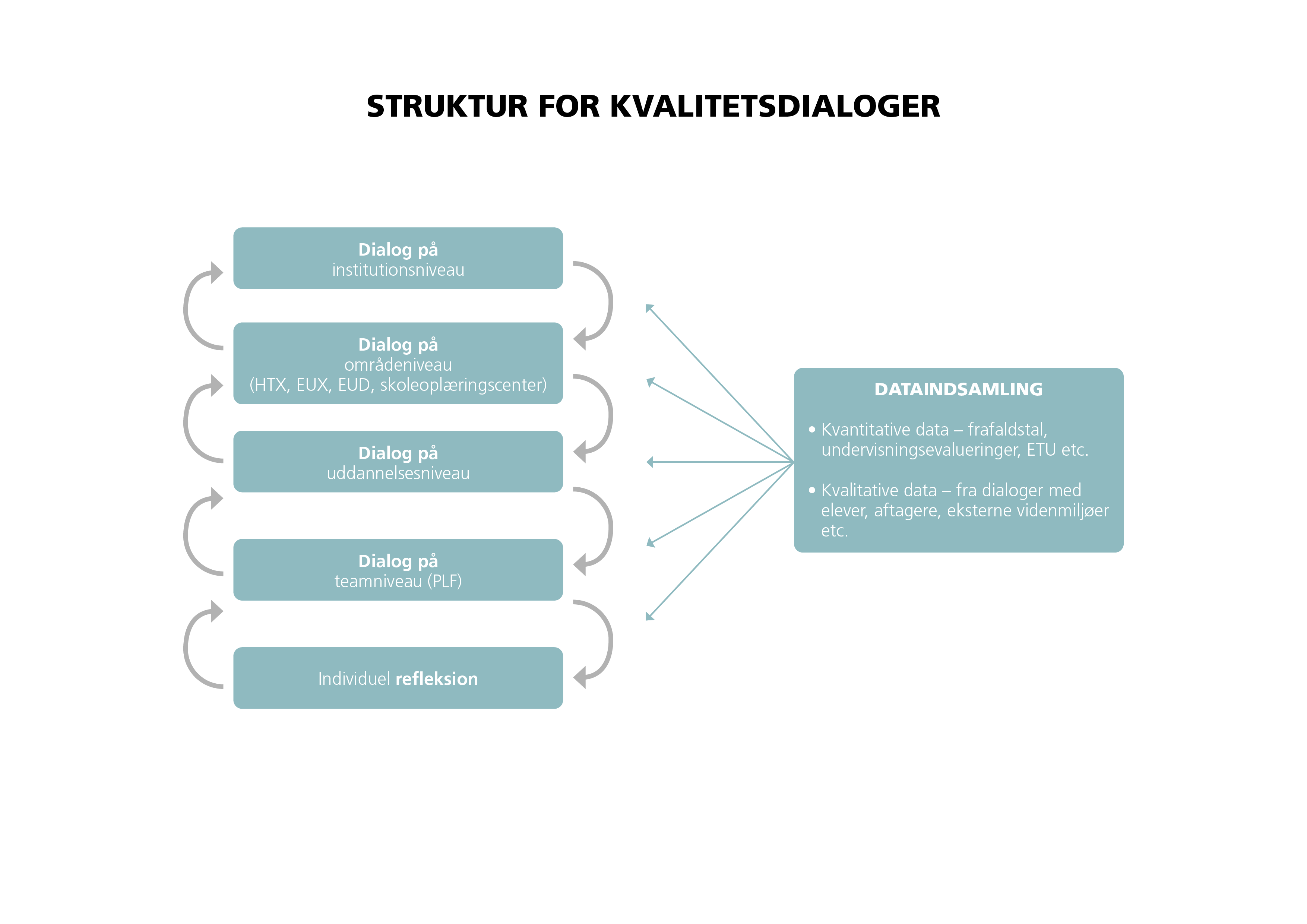
The level of individual reflection focuses on the fact that quality work starts with the individual's individual reflection on their own practice, as it is the individual actions of the individual employee in the meeting with the individual student that constitute the most direct influencing factor for the students' learning and well-being.
Dialogue at team level (PLF level) is the most crucial dialogue forum in the quality model in relation to developing the quality culture at Techcollege. It is in this context that the entirely process- and student-centered quality development must take place, so that efforts and initiatives are translated into concrete actions - for the benefit of our students.
Dialogue at the education level brings together the dialogue from the teams associated with the individual education. Here, the dialogue should focus on the joint development of the overall education, creating a common thread between the different courses, and sharing knowledge between the different PLF teams.
Dialogue at the area level particularly concerns cross-disciplinary sparring and knowledge sharing across education programmes. The quality system must therefore provide an overview and compare quality developments in our different education programmes with a view to creating inspiration and knowledge sharing around effective quality initiatives.
Dialogue at the institutional level concerns the dialogue within the executive board and the board of directors. It is crucial that the quality system ensures that senior management can create a coherent overview of the quality development in the institution's programmes, so that the strategic decisions made by top management support the quality development work that takes place at the programme and team level.
In order to implement the quality model, it is also crucial that coherence is created between the dialogues at the different levels, so that the dialogue at one level is connected to the dialogues at the adjacent levels. The quality work thus takes on the character of an integrated system, where decisions and actions across levels support and reinforce each other.
To ensure that the above model for quality development can be implemented in the organization, the following applies to the specific organization of quality work in Techcollege:
The management and board of directors are overall responsible for quality development at the institutional level and must therefore be able to form an overview of the quality development in the school's education programs.
The institutional efforts regarding quality work are organized under the management secretariat, which is responsible for organizing and implementing the institutional quality development processes.
The education management is responsible for the quality development in its own education area, including responsibility for ensuring that data-based quality dialogues are carried out at the education level and team level. Specifically, the education manager must also ensure that the education programs contribute to the annual self-evaluation, and that at least two annual departmental meetings are held with a focus on quality development of the education programs.
The individual educational leader is supported in this context by the quality trio, consisting of the educational leader himself, the associated pedagogical development consultant from Pædagogisk X, and the data and method consultant from the Management Secretariat. For the upper secondary school and school education, respectively, this meeting is however held as a joint meeting for the entire area management. The quality trio meets at least once a quarter to discuss the quality development within the associated educational programs.
There is a need to ensure a strong anchoring of quality work in the various PLF teams. In connection with the development of the general structures and framework for facilitating the PLF meetings, a clear division of responsibilities and roles for quality work in PLF contexts must also be defined, so that data-based quality dialogues are created that are centered around strengthening students' learning and well-being. As an element, a supporting model must also be developed in this context for how the various PLF teams - in an easy and clear way - can work with a minimum requirement for writing and documentation of quality work.
External involvement in quality work
Involving external stakeholders such as students, local education committees, companies, purchasing institutions, etc. is a core element of quality work. At Techcollege, we are committed to ensuring that we create an honest and constructive dialogue with external stakeholders, because they are a crucial source of knowledge about how we can best develop our education programs – for the benefit of students.
To ensure that there is sufficient attention to this obligation to create broad involvement and involvement in the quality work, the following minimum requirements for external involvement and involvement have been defined:
Any collection of data among students (teaching evaluations, ETU, etc.) must lead to a qualitative follow-up dialogue with the students.
The student councils for both vocational education and upper secondary school, as well as the local education committees, must be kept informed on an ongoing basis about the results of the ongoing information collection. They must also be specifically informed about the annual overall performance assessment.
The student councils for both vocational education and upper secondary schools, as well as the local education committees, must be involved in the work on self-evaluation and follow-up plans. The specific process for this involvement is planned taking into account the chosen theme for the self-evaluation.
Students, student councils, local education committees, companies, and client institutions can and must be involved in quality work when their perspective is assessed as being able to contribute significantly to quality development at the school - because the dialogue with external perspectives can make us more aware of how we can strengthen and develop the quality of our education programs.
Institutional annual cycle
The quality work is organized based on the following overall institutional process year wheel, which reflects the processes and structures described above, and adds an annual evaluation of the quality work at Techcollege, including evaluation of organization, models, structures, processes, etc.

Do you have any questions?

